At a Glance
Customer
Mid-Hudson Regional Information Center (MHRIC)
Industry
Education
Key Product
Mindex Integration Platform (MIP)
Website
Challenge
After moving SchoolTool to cloud hosting, the Mid-Hudson Regional Information Center (MHRIC) handed its integration scripts to Mindex and lost visibility into them. With roughly 30 districts running 425 integrations across 81 vendors, every question, schedule change, or failed file became a support ticket, and the back-and-forth peaked at the start and end of each school year.
Results
The Mindex Integration Platform (MIP) gave MHRIC direct visibility and control over district integrations. The team now schedules, tests, and troubleshoots integrations itself, reuses setups across districts, and has sharply reduced the tickets it sends to Mindex.
425
Integrations managed
81
Vendors connected
30
Districts supported
“It’s a major improvement to what we were doing in the past. It saves time. We can troubleshoot and identify problems ourselves instead of pushing it up to Mindex and asking for help.”
Sarah Dellaventura
Coordinator of Student Services
Mid-Hudson Regional Information Center
Customer Profile
About the Mid-Hudson Regional Information Center
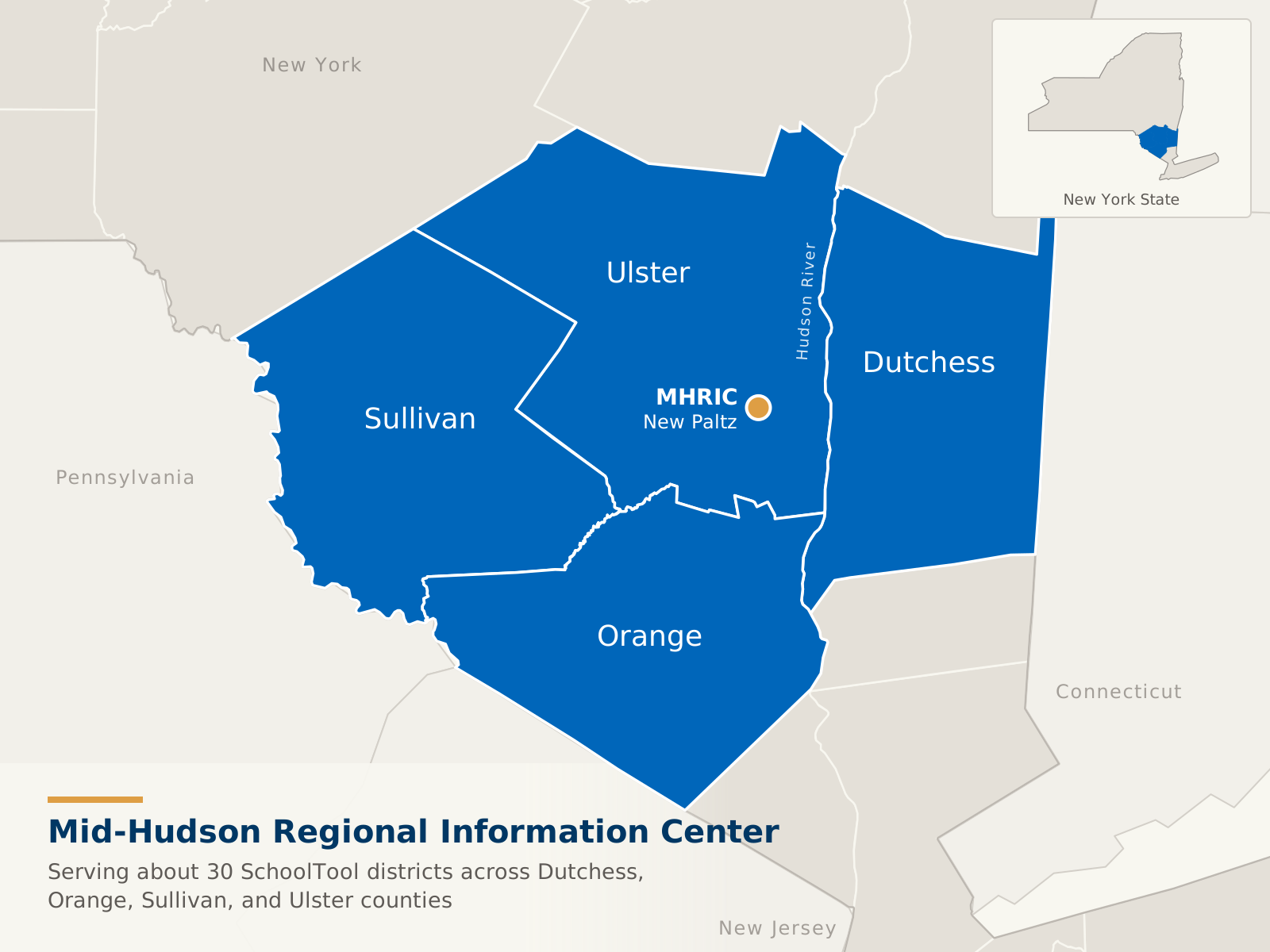
The Mid-Hudson Regional Information Center (MHRIC) is one of twelve New York State Regional Information Centers, based in New Paltz and serving school districts and BOCES across Dutchess, Orange, Sullivan, and Ulster counties.
Its student services team supports roughly 30 SchoolTool districts, each connected to the vendors and services, such as food service, that depend on SchoolTool data. MHRIC has used the Mindex Integration Platform since December 2025.

Opportunity
The Challenge: Bringing 81 Vendor Connections Back Within Reach
When MHRIC’s SchoolTool districts moved to Mindex cloud hosting, the RIC handed Mindex the stored procedures and scripts behind its district integrations. That kept the data flowing, but it also took the integrations out of MHRIC’s view.
- When a district had a question, the only option was to open a ticket with Mindex and wait.
- MHRIC’s districts run 425 integrations with 81 different vendors, and a single district can run anywhere from 2 to 15 integrations.
- The pressure peaked at the end and start of each school year, when districts needed everything running on schedule.
- MHRIC weighed handling the files itself, landing them on its own server and pushing them out to vendors. With SchoolTool already in the cloud, the team decided the Mindex Integration Platform was the better fit.
“We didn’t really have any visibility into it. Our districts have questions, especially at the beginning and end of the school year, when they need things up and running. There was a lot of back and forth.”
— Sarah Dellaventura, Coordinator of Student Services
Mindex Approach
The Solution: Putting Integrations Back in MHRIC’s Hands With MIP
What made it work:
- A phased rollout, led by Mindex: The Mindex team handled the bulk of implementation and opened MIP to MHRIC in stages, starting in December 2025. First the team could see into its integrations; as Mindex introduced each new capability, MHRIC took on more of the work. Within the year, the platform was part of MHRIC’s daily routine.

- Training the team could return to: Mindex walked MHRIC through each module of the platform and recorded the sessions, so staff could revisit them later. The team could also bring questions back to Mindex at any point.
- Testing on both sides: MHRIC gets to test new releases and features before they go live, then confirm on its end that everything works.
“We do like that we’re able to test the new releases that come out, or any new features. There’s testing on both sides, which is nice.”
— Sarah Dellaventura, Coordinator of Student Services
What changed with MIP:
- Year-end and back-to-school changes, handled in-house: MHRIC supports departments like food service whose extracts must be turned off at the end of the year and back on in September. That used to mean a dated ticket to Mindex for every change. Now the team makes the updates in MIP, tells the staff involved, and the job is done.
- Troubleshooting at the source: When a new integration starts up or a file looks wrong, MHRIC can pull the file down and see whether the problem is the file itself or the data in SchoolTool, before anything reaches the vendor.
- Failure alerts every morning: MIP sends failure notifications, so the team knows right away when something didn’t run. Staff can tell whether the issue sits with the vendor or the district and work directly with the right people.
- Set up once, reuse across districts: When one district uses a vendor integration, MHRIC can apply it to other districts instead of building it again. As districts add new vendors, that reuse saves time on every setup.
“We took all of that out because now we have the access. We can just go in and do it ourselves. That’s our busiest time of the year, and it cut back a lot.”
— Sarah Dellaventura, Coordinator of Student Services
Outcomes
The Results: Visibility and Control Over 425 Integrations
- MHRIC now helps its districts with integrations daily. Instead of filing tickets and waiting, the team sees the problem, checks the file, and fixes it or routes it to the right party.
- Tickets to Mindex have dropped sharply, especially during the busiest weeks of the school year.
- The team schedules seasonal changes itself, troubleshoots files before they reach vendors, catches failures with daily alerts, and reuses integrations across districts.
- The RIC team has felt the biggest change so far, but districts benefit too: their integrations get up and running, and get fixed, faster.
- MHRIC’s long-term goal is to give districts access to manage their own integrations.
“We’re able to troubleshoot them and test them and pull the files down, and see if there’s something wrong with the file itself or with the data in SchoolTool before it gets sent to the vendor. It cut back tremendously on the number of tickets we put in.”
— Sarah Dellaventura, Coordinator of Student Services
Advice for other RICs, in their words:
- Expect visibility, not just automation: The biggest shift for MHRIC was seeing into every integration instead of relying on tickets.
- Turn on failure notifications: Morning alerts let the team spot problems early and tell vendor issues from district issues.
- Reuse what works: An integration set up for one district can be applied to others, saving setup time as districts add vendors.
- Settle roles early: Agree up front on who on the team needs which level of access, and on consistent names for each integration.
- Use the training and testing: Recorded module walkthroughs and shared release testing help the team stay confident as the platform grows.